Self-leveling screed as a stable and reliable base for any floor
What is self-leveling screed
Self-leveling screed is a modern construction material designed for precise and fine leveling of floor surfaces. When mixed with water, it acquires a liquid consistency, allowing it to spread on its own and fill any unevenness on the base. This makes it particularly suitable for situations where a smooth surface is needed without manual leveling. Self-leveling screed creates a sense of order and stability from the very first stage of the flooring system.
Its main function is to serve as an intermediate layer between the rough floor and the final flooring. When this layer is executed correctly, floor coverings are installed more easily and remain in good condition for a longer period. Self-leveling screed eliminates small slopes, waves, and unevenness that could lead to problems over time. This makes it a practical solution that is not only important for aesthetics but also for comfort during daily use.
This kind of screed finds applications in both residential spaces and offices, shops, and public buildings. It is suitable for concrete bases, old cement floors, and underfloor heating systems. When done properly, it results in a level and durable surface that is resistant to load and time.
-
Even and precise leveling
-
Stable base for final flooring
-
Wide application in different building types
Preparation for self-leveling screed, priming
The preparation of the base is a crucial step when working with self-leveling screed. The floor must be thoroughly cleaned of dust, residues of old coverings, and greasy contaminants. Any unstable or loose areas should be removed to ensure a solid and even base. Skipping this step often compromises the final result.
After cleaning, priming is essential for proper adhesion between the base and the screed. The primer evens out the absorbency and prevents the material from drying too quickly. Without a quality primer, the self-leveling screed may lose part of its strength or develop defects. Therefore, using the right primers is a fundamental part of correct preparation.
Priming also facilitates the flow of the material and helps achieve an even layer. When the primer is applied evenly and is completely dry, the work process becomes more controlled and the result significantly better.
Suitable types of primer for priming
The choice of primer depends on the condition and type of the floor base. For porous and highly absorbent surfaces, deep-penetrating primers are used to stabilize the base. For smooth or dense floors, contact primers are applied to improve adhesion. Proper priming is a prerequisite for a durable self-leveling screed.
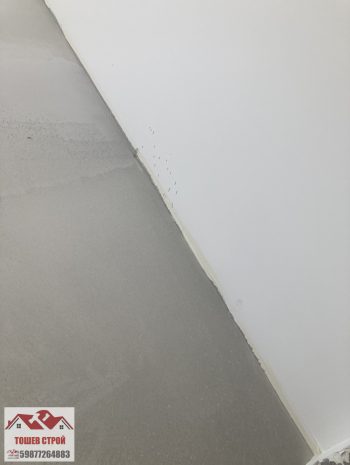
Preparation for self-leveling screed, filling joints with silicone
Joints and cracks are some of the most sensitive areas when preparing for self-leveling screed and should not be underestimated. They often form due to structural movements, building settling, or temperature differences. If left unfilled, there is a real risk that the self-leveling screed may leak, distribute unevenly, or crack later. Therefore, all joints need to be carefully treated before pouring. Filling with silicone provides elasticity and allows the floor to absorb minor movements without negatively affecting the screed.
Silicone jointing is particularly important for larger areas where stresses in the base are more pronounced. This is especially relevant for floors with underfloor heating, since materials expand and contract when heated or cooled. In these conditions, suitable silicones act as a compensating layer that protects the self-leveling screed and reduces the risk of cracking and deformation. Properly executed jointing contributes to an even distribution of stresses in the floor structure.
The choice of silicone depends on the specific load and intended use of the space. For standard interior joints, neutral silicone is most commonly used, as it does not react with cement materials and provides good adhesion. In areas with higher movement, temperature variations, or heavier loads, more elastic silicones are recommended, as they retain flexibility over time. Quality jointing with silicone is an important prerequisite for the long service life of the flooring system.
Advantages of self-leveling screed
Self-leveling screed offers numerous advantages that make it a preferred choice in modern construction. Its greatest benefit is the high precision it provides, which is difficult to achieve with traditional methods. Self-leveling screed ensures a smooth and even surface with minimal deviations.
Another important advantage is faster execution. When the base is properly prepared, with suitable primer and correct silicone jointing, the work process runs in an organized manner without unnecessary delays. This saves time and facilitates the next stages of renovation.
This kind of screed also stands out with its long service life. The combination of proper priming, quality primers, and reliable silicone jointing leads to a durable base that retains its properties over time.
Conclusion
Self-leveling screed is an effective and reliable solution for achieving a level and durable floor. When self-leveling screed is applied with the appropriate primer, careful priming, and quality silicone jointing, the result is a solid base suitable for all types of flooring. Using the right primers and proper silicones ensures comfort, security, and a long life for the flooring system.
If you need floor screeding, whether it is self-leveling or traditional, we are here to help with this endeavor! Toshev Stroy Construction Company offers a wide range of construction services, equipped with modern technical equipment and construction machinery.