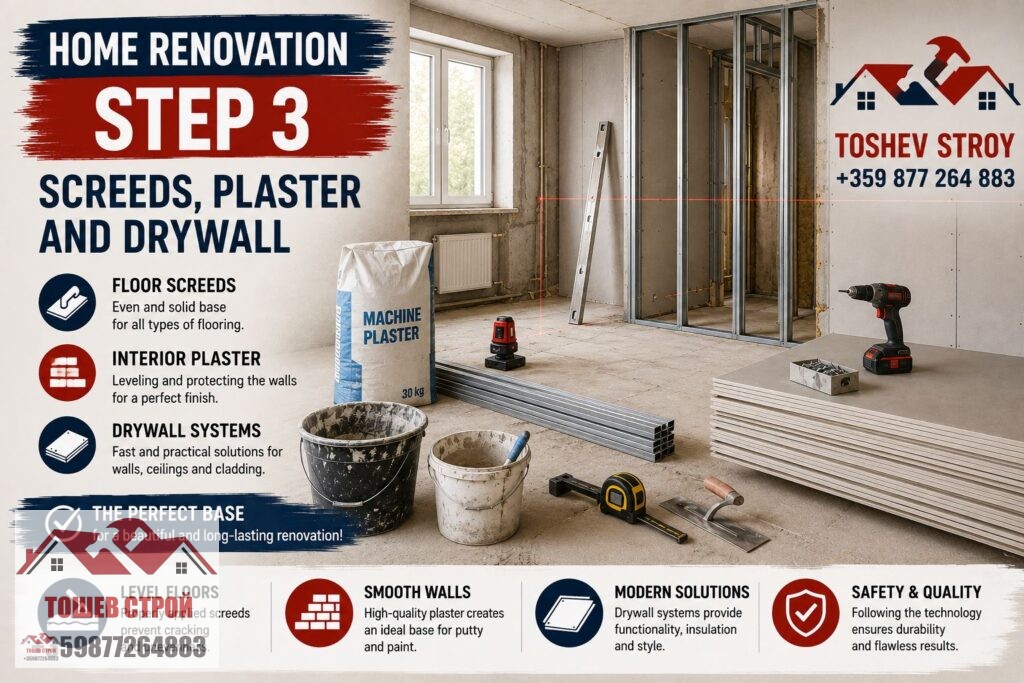

Screeds and plaster – drywall – step 3
- CONSTRUCTION BLOG
Screeds, plaster and drywall – Step 3
Why is this stage so important?
After the plumbing and electrical installations have been completed, the next key stage of the renovation begins – installing floor screeds, interior plaster, and drywall systems. This is the stage where the foundation is created for the skim coat, paint, flooring, and all other finishing materials that will follow. When these construction activities are carried out properly, every subsequent stage becomes more efficient and the final result is more precise.
Floor screeds and plaster are much more than preparation layers. They provide the required strength, level surfaces, and structural stability throughout the property. When necessary, drywall systems are also installed at this stage to create partition walls, suspended ceilings, or decorative architectural features. Completing these tasks in the correct order ensures that the finishing work begins on a properly prepared surface.
What does this stage include?
Once the installation work has been completed, the rooms are ready for restoring the walls, floors, and ceilings. The individual operations depend on the condition of the property and the renovation project, with each task preparing the way for the next stage of the renovation.
This stage most commonly includes:
- Installation of floor screeds.
- Application of interior plaster.
- Repair of damaged walls and ceilings.
- Installation of drywall systems.
- Construction of drywall lining systems.
- Installation of suspended ceilings where required.
- Preparation of all surfaces for skim coating.
Why is the correct sequence important?
Every construction material requires a specific application method, drying period, and curing time before reaching its designed strength. If any process is skipped or carried out at the wrong stage, it can affect the quality of the finishing work that follows. For this reason, the correct construction sequence should be followed from the very beginning of the renovation.
Properly installed screeds, plaster, and drywall systems make skim coating, painting, and flooring installation much easier. Smooth and stable surfaces reduce the need for additional corrections, save time during the renovation, and provide the conditions required for high-quality finishing work.
Floor screeds
What is the purpose of a floor screed?
A floor screed is one of the most important structural layers in an interior renovation. Its primary purpose is to level the subfloor, provide the necessary strength, and create a suitable surface for the final floor covering. Whether the project includes laminate flooring, hardwood, porcelain tiles, ceramic tiles, or vinyl flooring, a properly installed screed is essential for achieving a durable and reliable result.
In addition to leveling the floor, a screed can correct differences in floor height between rooms and create the required slopes in wet areas. In new construction and major renovations, it is also commonly used to cover service installations while providing a stable base for all subsequent finishing work.
Which types of floor screeds are most commonly used?
The choice of floor screed depends on the intended use of the room, the condition of the existing subfloor, and the type of flooring that will be installed. Each type has specific characteristics that should be considered during the planning stage of the renovation.
The most common types include:
- Cement screed.
- Self-leveling screed.
- Fast-drying screed.
- Screed for underfloor heating systems.
- Floor leveling compounds for minor unevenness.
- Reinforced screeds where required.
Why is the quality of the screed so important?
Even the highest-quality flooring cannot compensate for a poorly executed screed. Uneven surfaces, insufficient strength, or improper curing may result in cracks, movement of the flooring, or unwanted squeaking during everyday use. This is why this stage requires careful workmanship and strict compliance with the recommended installation procedures.
Before the flooring is installed, the screed must be completely dry and have reached its required strength. Following the recommended curing time is essential for the proper installation of the floor covering and for ensuring its long-term performance.
Interior plaster
Why is plaster important for a quality renovation?
Once the floor screeds have been completed, the next stage is the application of interior plaster. Its primary purpose is to level the walls and ceilings, restore surfaces after construction work, and provide a solid base for skim coating. Properly applied plaster improves not only the appearance of the rooms but also the quality of all finishing materials that will be applied afterward.
Besides leveling surfaces, plaster protects the masonry from mechanical damage and helps create a smooth and even finish. It allows uneven areas to be corrected, wall chases from utility installations to be filled, and damaged walls to be restored after demolition work. For this reason, plastering is an essential part of most major renovation projects.
Which types of interior plaster are commonly used?
The choice of plaster depends on the substrate, the purpose of the room, and the conditions in which it will be used. Each material offers different properties that make it suitable for specific applications.
The most commonly used types include:
- Cement plaster.
- Cement-lime plaster.
- Gypsum plaster.
- Machine-applied plaster.
- Hand-applied plaster.
- Repair plaster for local restoration work.
What are the advantages of properly applied plaster?
Properly applied plaster creates a stable and even surface that allows skim coats and paint to adhere uniformly. This reduces the consumption of finishing materials and makes it easier to achieve a smooth final appearance. It also minimizes the risk of future defects such as cracking, peeling, or uneven finishes.
High-quality plastering also contributes to the long-term durability of the renovation. When walls and ceilings are properly leveled at this stage, the following finishing work can be completed more efficiently, while the need for additional corrections is significantly reduced.
Drywall installation
When is drywall the best solution?
Drywall installation is carried out after the main utility installations have been completed whenever new partition walls, suspended ceilings, or wall linings are required. This system makes it possible to shape interior spaces quickly without relying on wet construction methods to the same extent as traditional masonry. It also provides an efficient way to conceal electrical wiring, plumbing pipes, ventilation ducts, and other building services while creating a smooth surface for the finishing work.
When installed correctly, drywall systems are durable, practical, and suitable for both residential and commercial properties. Depending on the intended application, standard, moisture-resistant, or fire-resistant boards can be used. The appropriate system should always be selected according to the room conditions and the project requirements.
Where is drywall most commonly used?
Thanks to its versatility, drywall is widely used in many types of interior renovation projects. In addition to creating new structures, it is frequently used to correct uneven walls and ceilings or to build decorative architectural features.
Drywall is most commonly used for:
- Building partition walls.
- Installing suspended ceilings.
- Wall lining systems.
- Concealing building services.
- Creating niches and decorative elements.
- Improving thermal and acoustic insulation when appropriate systems are used.
What are the advantages of drywall systems?
One of the greatest advantages of drywall is the ability to achieve fast installation with a high level of precision. Once properly installed, the surfaces are ready for skim coating, reducing the preparation time before painting or applying decorative finishes. Drywall systems also provide easier access to concealed installations if future repairs or modifications become necessary.
When quality metal profiles, suitable plasterboards, and the correct installation methods are used, drywall systems provide long-term durability and structural stability. Combined with mineral wool or other insulation materials, they can significantly improve acoustic comfort and thermal performance without placing excessive loads on the building structure.
Screeds, plaster and drywall – Step 3, conclusion
Floor screeds, interior plaster, and drywall installation create the foundation for all subsequent finishing work. At this stage, level walls, stable floors, and completed drywall structures are prepared for skim coating, painting, and flooring installation. The more accurately these construction activities are completed, the higher the quality and durability of the finished renovation.
In Step 4, we will examine skim coating and surface preparation for painting, explaining why proper surface leveling is essential for a flawless finish and how this stage affects both the appearance and long-term durability of an interior renovation.
Follow us on FB.
PARTHNERS
FOLLOW US:

Puttying and preparation for painting step 4 home renovation
Puttying and preparation for painting should be carried out on a sound, dry, and properly prepared surface. Puttying is a key stage before painting because

Screeds and plaster – drywall – step 3
Once the planning, demolition, and dismantling work has been completed, the next key stage of the renovation begins. This is when all work related to

Home renovation – Step 2
Once the planning, demolition, and dismantling work has been completed, the next key stage of the renovation begins. This is when all work related to

Planning demolition and dismantling, the beginning…
Planning demolition and dismantling mark the beginning of every renovation project. Before upgrading a home, it is important to understand the correct order of apartment

10 reasons to paint with latex
Every home needs refreshing from time to time. One of the easiest ways to transform the atmosphere is with a new wall color. That is
RELATED SERVICES WITH PUBLICATION
Self-leveling screeds
Self-leveling screeds are a modern solution for creating a smooth, durable, and aesthetically finished floor base. Toshev Stroy offers professional application of self-leveling screeds, tailored to the technical requirements of each site and the individual needs of the client. With extensive experience and a high standard of execution, the company ensures reliability, longevity, and uncompromising quality.
DRYWALL
With TOSHEV STROY, you infuse your home with the quality and innovation you deserve. Our experienced team offers drywall solutions designed to transform your interior with elegant and functional systems. Whether it’s about installing suspended ceilings, constructing
Floor and tile repair
Tile installation is one of our primary services that transforms the interiors of both homes and office spaces. Our experienced team focuses on every detail to create a finished look that seamlessly combines aesthetics and functionality, using high-quality materials and modern installation techniques.